Treatment of uterine fibroids (2) Other treatments
Healthcare
About This Information:
This English version is a translation of content originally created based on medical information used in Japan. Accordingly, the data and treatment approaches presented reflect the situation in Japan and may differ from those in other countries or regions.
Supervised by: Dr. Shiro Onozawa (Associate Professor, Department of Radiology, Kyorin University Faculty of Medicine)
Uterine Artery Embolization (UAE)
Uterine artery embolization (UAE) shrinks fibroids by blocking the blood vessels that supply them, cutting off their source of nutrients.
-
How the treatment works
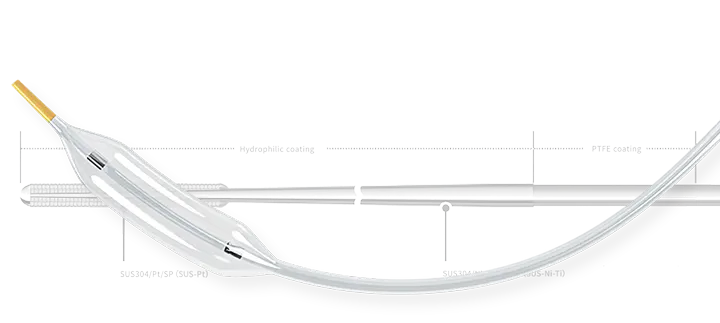
A thin tube (catheter) is inserted through a blood vessel in the groin and guided to the uterine artery, where small particles are injected to block the blood flow to the fibroids. -
Features
The procedure is performed under local anesthesia and leaves no large abdominal scar. It has been covered by health insurance in Japan since 2014 and is now widely used. -
Points to consider
Because the potential effects on future pregnancy have not been fully ruled out, UAE is not currently recommended for women who hope to become pregnant. Fibroids may grow back over the course of several years, and repeat treatment may be considered depending on how the condition develops. -
Typical length of hospital stay
Usually about a few days to 1 week. -
Suitable cases
Women who wish to preserve the uterus, avoid surgery, or find relief from symptoms
Microwave Endometrial Ablation (MEA)
Rather than removing the fibroids themselves, microwave endometrial ablation (MEA) treats the endometrium (the lining of the uterus), which is the source of bleeding, in order to reduce heavy menstrual bleeding caused by fibroids.
-
How the treatment works
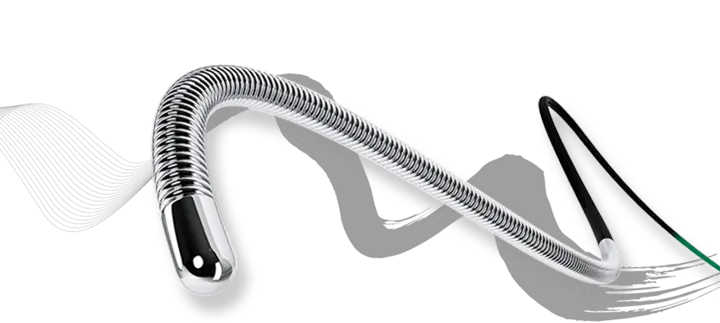
A thin instrument is inserted into the uterus through the vagina, and microwaves (the same principle used in a microwave oven) are used to heat and coagulate the endometrium, reducing the volume of menstrual bleeding. -
Features
MEA is especially effective for women suffering from anemia caused by heavy menstrual bleeding, or from prolonged bleeding. It is a valuable option for women who wish to avoid a total hysterectomy. MEA is covered by health insurance. -
Points to consider
Because MEA treats the endometrium itself, it cannot be performed on women who hope to become pregnant in the future. Because its effect on reducing the size of the fibroids themselves is limited, MEA has little impact on symptoms caused by the fibroids directly, such as abdominal bloating or frequent urination. -
Typical length of hospital stay
Typically a same-day discharge, or a hospital stay of a few days. -
Suitable cases
Women with no plans for future pregnancy who are suffering from heavy menstrual bleeding.
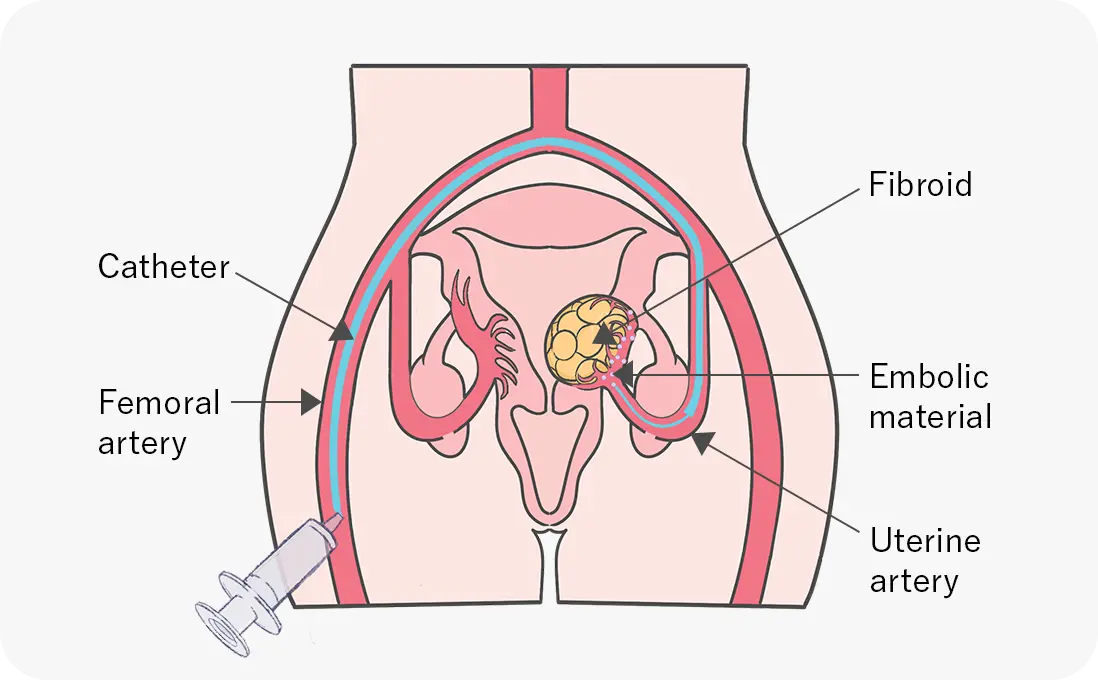
Uterine Artery Embolization (UAE): A uterus-preserving treatment without abdominal incisions
Uterine artery embolization (UAE), a procedure that treats fibroids while preserving the uterus, is becoming increasingly common in Japan.
Originally developed and widely used overseas, UAE was approved for health insurance coverage in Japan in 2014. In recent years, clinical guidelines have been established, and a growing number of medical institutions are now able to offer the procedure.
UAE uses a thin tube called a catheter to reduce the flow of blood to the arteries supplying the fibroids, causing them to shrink. Because no abdominal incisions are made, UAE places relatively little strain on the body. The procedure is performed under local anesthesia, with the catheter inserted through the groin. It leaves little visible scarring and generally requires only a relatively short hospital stay.
However, fibroids may grow back after treatment, and repeat treatment is sometimes needed. Because there are concerns about possible effects on future pregnancy, women who hope to become pregnant should consider the procedure carefully. UAE may not be appropriate in cases where malignancy is suspected, so it is important to discuss your situation thoroughly with your doctor. UAE is drawing attention as a new option for women who wish to preserve their uterus, avoid surgery, or for whom medication has not been sufficiently effective.