

Uterine Fibroids
Healthcare
About This Information:
This English version is a translation of content originally created based on medical information used in Japan. Accordingly, the data and treatment approaches presented reflect the situation in Japan and may differ from those in other countries or regions.
Supervised by: Dr. Megumi Yokota (Lecturer, Department of Obstetrics and Gynecology, Hirosaki University Graduate School of Medicine)
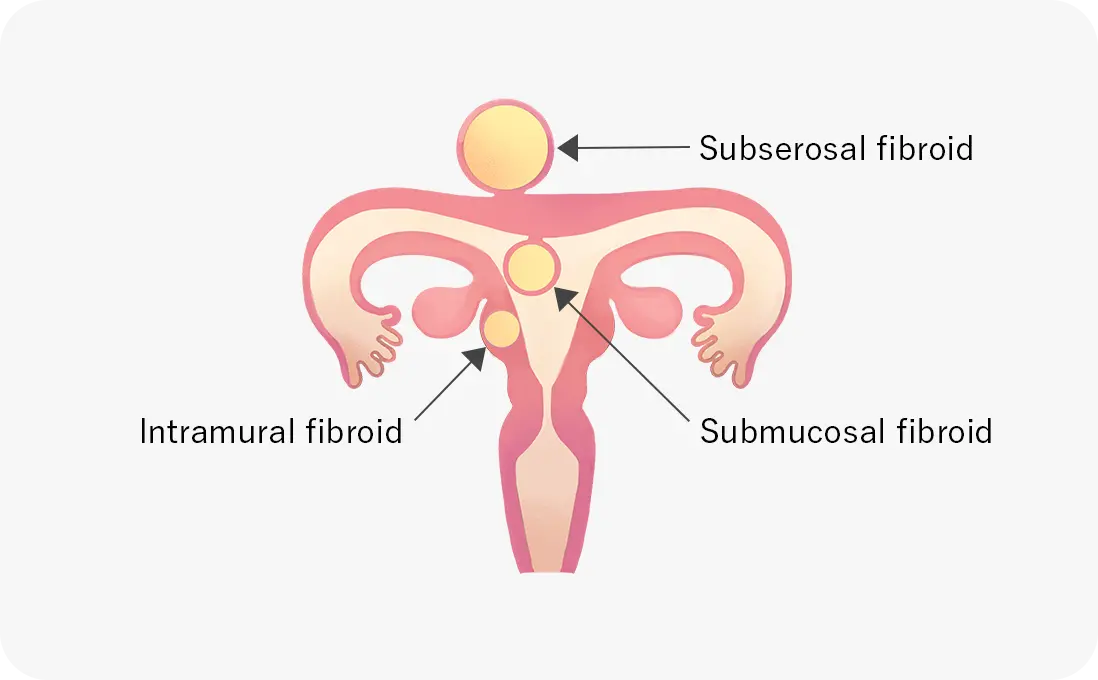
Uterine fibroids are a condition in which benign lumps (bumps) develop in the muscle tissues of the uterus. A fibroid is a benign tumor that forms as the muscular cells grow. It is a very common condition in women, said to occur in approximately one in three women aged 30 or older, with diagnoses becoming especially common in women in their forties. Fibroids are classified as follows based on their location:
|
Subserosal fibroids |
Subserosal fibroids develop protruding outward from the uterus. |
|---|---|
|
Intramural fibroids |
Intramural fibroids grow within the wall of the uterus (in the muscle layer) and are the most common type. |
|
Submucosal fibroids |
Submucosal fibroids develop on the inner side of the uterus (beneath the endometrium) and tend to cause symptoms even when small. |

Causes of fibroids
The female hormone estrogen plays a significant role in uterine fibroids. Estrogen is an essential hormone that prepares woman’s body for pregnancy; however, it is also considered one of the factors that cause fibroids to grow.
Fibroids are thought to be more likely to develop under the following conditions.
-
Having a female relative aged 30 to 50 who has had uterine fibroids (genetic predisposition)
-
A higher number of lifetime menstrual cycles (early onset of menstruation or late menopause)
-
A lifestyle or environment that tends to disrupt hormonal balance, such as obesity or stress

What is a benign tumor? How does it differ from cancer?
A fibroid is a benign tumor. A tumor is a lump formed by the proliferation of cells in the body. The difference between "benign" and "malignant (= cancer)" is that benign tumors do not invade surrounding tissues or metastasize, whereas malignant tumors can spread to other parts of the body.
Fibroids rarely spread to other organs like cancer does and most fibroids grow slowly. For this reason, if symptoms are mild, monitoring without active treatment may be sufficient.
That said, there is, very rarely, a malignant tumor called "uterine sarcoma" that can resemble a uterine fibroid in appearance. In particular, when a tumor grows rapidly or shows signs of internal bleeding, detailed imaging studies are important. Identifying such cases early allows for a more appropriate treatment plan.
Symptoms of fibroids
The symptoms of fibroids vary depending on their location and size. Some women have no noticeable symptoms at all, while others experience symptoms severe enough to interfere with daily life.
Common symptoms include:
|
Heavy menstrual bleeding (menorrhagia) |
Menstrual periods may involve blood clots or last longer than usual. This can lead to anemia and fatigue. |
|---|---|
|
Severe menstrual pain (dysmenorrhea) |
Severe lower abdominal pain and lower back pain may occur during menstruation. This is caused by excessive uterine contractions triggered by the fibroids. |
|
Tightness and pain in the lower abdomen |
When fibroids grow large, a feeling of heaviness or bloating in the lower abdomen may occur independently of menstruation. |
|
Frequent urination and constipation |
These occur when the enlarged uterus presses on the bladder and intestines. |
|
May contribute to infertility or miscarriage |
Depending on the location of fibroids, they may make it harder for a fertilized egg to implant or for a pregnancy to be maintained. |
On the other hand, many women have no symptoms at all. In such cases, fibroids are sometimes discovered incidentally during a routine health check or gynecological examination. Whether treatment is needed or whether watchful waiting is appropriate depends on the severity of the symptoms and how much they affect daily life.